

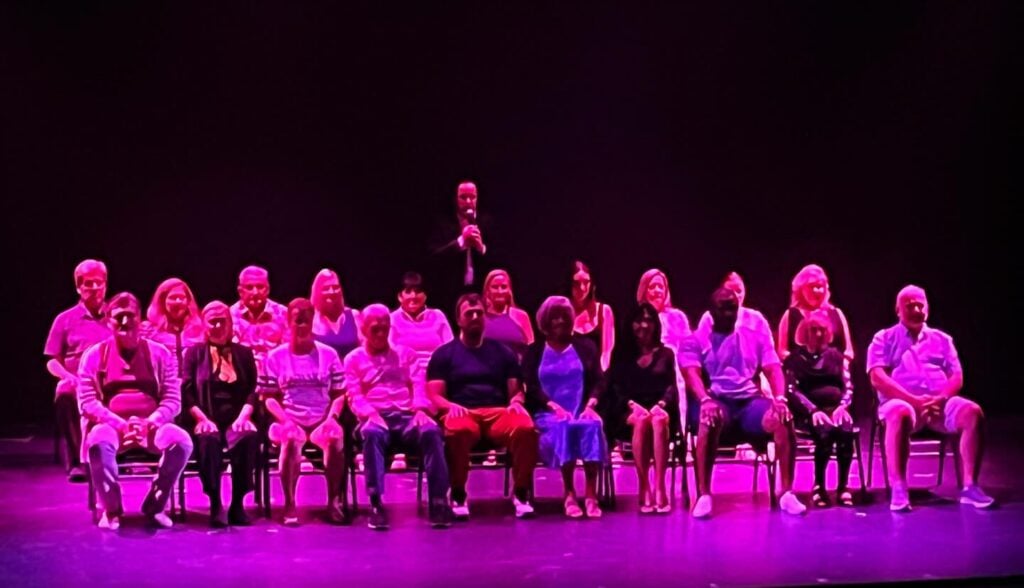
Last updated September 21, 2026 · By Richard Barker, The Incredible Hypnotist
Short answer: yes, stage hypnosis is real, and the volunteers are not actors. What you see on stage is real hypnosis, amplified by volunteer selection, social pressure and showmanship. The American Psychological Association’s Division 30 defines hypnosis as a state of consciousness involving focused attention and reduced peripheral awareness, with an enhanced capacity to respond to suggestion. Volunteers stay aware, can stop at any time, and won’t act against their values.
Scientists still debate the mechanism. Some researchers explain stage behavior as an altered state of consciousness, while others point to ordinary psychology in a group setting. After 6,000 shows, I think both are true at once, and this article shows you where each one does its work.
I have hypnotized over 100,000 people on stage. After 20 years, 6,000 shows across 38 countries, and appearances on the Today Show and The Late Late Show with James Corden, I hear the exact same question every single night after the curtain falls:
“Is stage hypnosis real? Or are those people just acting?”
It is the ultimate elephant in the room. When you watch a grown man cluck like a chicken or someone forget their own name, skepticism is your natural (and healthiest) response.
Here is the honest truth about what happens on stage, the science of the human mind, and why stage hypnosis is entirely real, but rarely in the way you think it is.
The Core Question: What Is Stage Hypnosis?
Stage hypnosis is a highly specialized form of entertainment that relies on a genuine psychological phenomenon: hypnotic suggestibility.
There are no actors, no paid stooges, and no magic tricks. The people on stage are genuine volunteers from the audience. However, stage hypnosis is distinctly different from clinical hypnotherapy.
Entertainment vs. Clinical Hypnosis
Clinical Hypnotherapy
Conducted in a private, quiet setting. The goal is therapeutic change — quitting smoking, overcoming trauma, managing pain. The trance state is deeply relaxing and introspective.
Stage Hypnosis
Conducted in a highly stimulating, public environment. The goal is entertainment. The trance state is dynamic, active, and fueled by the energy of a live audience.
The Reality Check: While the environments and goals differ entirely, the underlying neurological mechanism — bypassing the critical faculty of the conscious mind to access the subconscious — is exactly the same.
How It Actually Works: The Blueprint of a Show
The success of a stage hypnosis show doesn’t rely on mystical powers — it relies on psychology, environment, and precise selection. Here is the step-by-step breakdown of how a professional makes it happen.
1. The Pre-Talk (Setting the Hypnotic Contract)
Before I even ask for volunteers, I am subtly conditioning the audience. Whether I’m performing in a theater in London or doing a segment for national television, I set clear expectations. I remove fear, build excitement, and establish authority. This creates a “hypnotic contract” where the audience agrees to follow instructions.
2. The Selection Process (Finding the Somnambulists)
This is the true secret of stage hypnosis. Not everyone can be hypnotized easily in a noisy theater. We are looking for highly suggestible individuals — often referred to in the industry as “somnambulists.”
Stanford Medicine reports that only about 10 percent of the population is generally categorized as highly hypnotizable. Dr. David Spiegel adds that about two-thirds of people are somewhat hypnotizable and about a third are not. In a room of 1,000 people, that gives me roughly 100 natural subjects, and my suggestibility tests exist to find them quickly. Through rapid suggestibility tests (like asking the audience to clasp their hands together tightly), I filter out the skeptics, the over-thinkers, and the analytical minds, inviting only the highly responsive individuals to the stage.
3. The Induction (Bypassing the Critical Mind)
Once the right subjects are on stage, the induction process begins. This is a sequence of rapid, authoritative commands designed to overload the conscious mind. By giving the brain too much sensory information to process at once, the critical factor “steps aside,” leaving the subconscious wide open to suggestion.
Why Do Volunteers Comply? The Psychology of the Stage
If I walked up to a stranger on the street and told them to dance like a ballerina, they would walk away. Why do they do it on stage? The answer is a potent cocktail of psychology.
The Amplifiers of Compliance
- The Spotlight Effect: Being on stage under bright lights in front of hundreds of people creates a profound sense of pressure to conform.
- Social Proof: When a volunteer sees the person next to them slumping into a deep trance, their brain subtly signals that they should be doing the same thing.
- Lowered Inhibitions: Hypnosis feels akin to having a few drinks. You know what you are doing, but you simply don’t care. Your internal editor is turned off.
- The “Play Along” Phenomenon: Do some people fake it? Occasionally, yes. A small percentage of volunteers will consciously play along because they want to be part of the show. However, a skilled hypnotist spots them quickly and dismisses them, keeping only the genuine subjects.
What the brain scans show
In 2016, Stanford researchers scanned the brains of 57 people during guided hypnosis and published the results in Cerebral Cortex. They found three changes:
- Less activity in the dorsal anterior cingulate. This area belongs to the brain’s salience network. Dr. Spiegel explains that in hypnosis you’re so absorbed that you’re not worrying about anything else.
- A stronger connection between the dorsolateral prefrontal cortex and the insula. Spiegel describes this as a brain-body link that helps the brain process and control what’s going on in the body. In my experience, this is why “you’re stuck to your chair” works so well.
- A weaker connection between the dorsolateral prefrontal cortex and the default mode network. Spiegel says this likely reflects a disconnect between a person’s actions and their awareness of those actions. On stage, that looks like a volunteer who simply stops being self-conscious.
Each change showed up only in the highly hypnotizable group, and only while they were under hypnosis.
An honest caveat: this study used guided, clinical-style hypnosis, not a comedy stage. It shows that hypnosis is a measurable brain state. It doesn’t show that every volunteer in every show is in that state. That’s exactly why selection matters so much. The APA Monitor’s 2024 overview, Uncovering the new science of clinical hypnosis, is a good next read if you want the research side.
What does it feel like to be hypnotized on stage?
Most volunteers describe it as being completely absorbed, like being lost in a good film. You hear the audience. You know where you are. You just stop caring how you look, and the suggestions feel easier to follow than to fight. Afterward, most people remember the show and feel relaxed.
Debunking the Biggest Myths of Stage Hypnosis
After 6,000 shows, I have heard every misconception imaginable. Let’s clear the air.
Myth 1: The Hypnotist Controls Your Mind
False. Hypnosis is a state of mutual cooperation. I cannot make anyone do something that fundamentally violates their moral code. If I handed a hypnotized subject a real weapon and told them to use it, the shock to their survival instinct would instantly shatter the trance.
Myth 2: You Might Reveal Deep, Dark Secrets
False. You are not under a truth serum. While your inhibitions are lowered, your subconscious is still fiercely protective of your survival and social standing. You will not blurt out your bank PIN or confess your darkest secrets.
Myth 3: You Can Get Stuck in Hypnosis
False. Trance is a natural, shifting state. If a hypnotist were to leave the stage and walk out of the building, the volunteers would simply realize the show was over and naturally wake up — or drift into a normal sleep and wake up refreshed a few minutes later.
Watch Richard explain it live
Richard Barker, as seen on The Today Show (NBC) and The Late Late Show with James Corden (CBS)
The Verdict
Is stage hypnosis real? Absolutely. It is a stunning display of human psychology, neurological suggestibility, and masterful stagecraft. When you watch a great show, you are not watching actors reading a script — you are watching the raw, unfiltered power of the human imagination unleashed in real-time.
After two decades of performing everywhere from small comedy clubs to major television networks, the magic hasn’t faded for me. The mind is the most powerful instrument on earth — and stage hypnosis is just a front-row ticket to watching it work.
Book Richard Barker
Want to see stage hypnosis live at your next event?
Richard Barker performs comedy hypnosis shows for corporate events, colleges, theaters and private events across the USA and internationally. Shows start at $1,200.
Try the Hypnosis Hub App Free
If you want to experience hypnosis for yourself, the Hypnosis Hub app is the easiest place to start. It includes a free guided breathing program to calm your nervous system on demand, plus a full hypnosis audio session designed to help you sleep deeper and break the insomnia cycle. No subscription required to try it.
Download Hypnosis Hub Free, or scan the QR code above from your phone.
Is Stage Hypnosis Real? FAQ
Does stage hypnosis really work?
Yes, for people who are willing and responsive. About 10 percent of people are highly hypnotizable, according to Stanford Medicine, and most others respond to some degree. It does not work on someone who refuses to take part.
Is stage hypnosis real or fake?
It is real. The volunteers are genuine audience members, not actors. The hypnotist selects the most responsive people, and the stage setting amplifies their reactions. A few volunteers do play along, and a good hypnotist sends them back to their seats.
What does it feel like to be hypnotized on stage?
It feels like deep absorption, similar to being lost in a film. You stay aware of the room and the audience. You feel relaxed and uninhibited, and you can stop whenever you choose.
Is getting hypnotized actually real?
Yes. The American Psychological Association’s Division 30 defines hypnosis as focused attention with reduced peripheral awareness and an enhanced response to suggestion. Stanford brain scans show measurable changes in highly hypnotizable people during hypnosis.
Is stage hypnosis dangerous?
A professionally run show is safe. You keep your judgment, you cannot get stuck, and the hypnotist brings every volunteer back to full alertness before the show ends.
Can a stage hypnotist make you do anything?
No. Hypnosis depends on cooperation. You will not act against your values, and you will not reveal secrets. More in Can a hypnotist make you do anything?
