

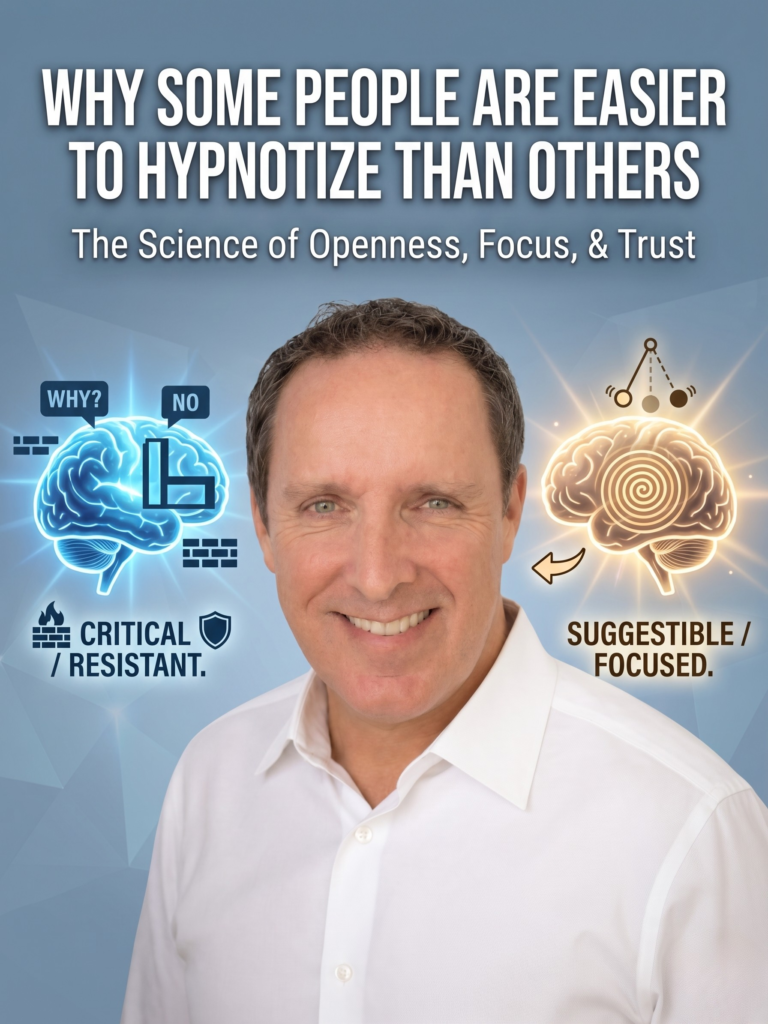
You’ve seen it happen. One person walks on stage, and within seconds their eyes roll back and they’re gone. The next person sits there, arms crossed, fighting it the whole time. Why are some people easier to hypnotize while others seem completely immune? After hypnotizing thousands of people across live stages and private sessions, I can tell you the answer isn’t what most people expect.
Why Are Some People Easier to Hypnotize? It Starts in the Brain
Here’s what most hypnotists won’t tell you: hypnotizability isn’t about being weak-minded, gullible, or naive. It’s the opposite. Research from Stanford University found that highly hypnotizable people have stronger functional connectivity between two specific brain regions, the dorsolateral prefrontal cortex and the dorsal anterior cingulate cortex. In plain language? Their brains are better wired for deep, focused attention.
That’s it. No magic. No personality flaw. Just a brain that’s built to lock in and tune out everything else. Think of it like a signal-to-noise ratio. Some people’s brains naturally filter out distractions while amplifying the voice guiding them. Others have more noise competing for bandwidth.
This is why intelligent, creative, focused individuals often make the best hypnotic subjects. If you’ve ever gotten so absorbed in a book that someone had to say your name three times, you’re probably a natural. If you’ve cried during a movie you’ve already seen twice, same thing. That capacity to fully immerse yourself in an experience is the single biggest predictor of how deeply you’ll go under.
Psychologists call this trait absorption, and it’s the closest thing we have to a hypnotizability superpower.
Wondering what this means for the volunteers you see at a show? Here’s my sourced answer to is stage hypnosis real.
The 5 Traits of Highly Hypnotizable People
After two decades of performing stage hypnosis shows and working with clients in hypnotherapy sessions, I’ve noticed consistent patterns. The people who go deepest, fastest, almost always share some combination of these five traits.
1. Vivid imagination. They don’t just think about a lemon, they taste it. Their mental imagery carries weight. When I suggest their hand is floating, they don’t analyze it. They feel it lift.
2. Willingness to let go. This is the one people underestimate. You can have the most hypnotizable brain on the planet, but if you’re sitting there thinking “prove it,” you’ve already built a wall. The volunteers who go deepest on my stage aren’t the ones trying hardest. They’re the ones who decided to stop trying.
3. Strong focus under stimulation. Paradoxically, the best hypnotic subjects aren’t the most relaxed people in the room. They’re the ones who can maintain laser focus even when there’s chaos around them. Loud music, bright lights, a crowd of 500 people watching, and they stay locked on my voice.
4. Prior experience with trance states. Meditation. Flow state during sports. Getting lost in music. These are all cousin experiences to hypnosis. If your brain has practiced going there before, it knows the path. The neural highways are already paved.
5. Emotional openness. Not vulnerability in the fragile sense. More like emotional fluency. People who feel things fully, laugh easily, get genuinely moved, they respond to suggestion because they’re already comfortable with internal experience shifting their state.
Myths About Hypnotizability That Need to Die
Let’s clear the air on a few things that get repeated constantly and are completely wrong.
“Only weak-minded people can be hypnotized.” This might be the most persistent myth in the entire field. The research shows zero correlation between hypnotizability and submissiveness, gullibility, or low intelligence. In fact, higher intelligence and stronger executive function tend to increase hypnotic responsiveness. The ability to focus deeply is a cognitive strength, not a weakness.
“You either can or can’t be hypnotized.” Hypnotizability exists on a spectrum. About 10-15% of people are highly hypnotizable, 10-15% have low hypnotizability, and the vast majority fall somewhere in the middle. Where you land can shift based on context, trust in the hypnotist, and how many times you’ve experienced it before.
“Hypnosis is about losing control.” Nobody loses control during hypnosis. Ever. What happens is you gain access to a different kind of control, the kind where your conscious mind steps aside and lets your subconscious run the show for a while. It’s the same thing that happens when you’re driving home and suddenly realize you don’t remember the last three turns. You were in control the entire time. Your autopilot just took over.
I’ve had audience members come up to me after a corporate show convinced they couldn’t be hypnotized because they “remembered everything.” That’s normal. Remembering doesn’t mean it didn’t work. It means your conscious mind was observing while your subconscious was responding. Two separate systems, both online at the same time.
What a Stage Hypnotist Sees That You Don’t
When I’m scanning an audience before a college show or festival performance, I’m reading dozens of micro-signals that most people miss entirely. The person leaning forward slightly. The one whose eyes are already starting to defocus during my introduction. The volunteer whose breathing pattern shifts the moment I change my vocal tone.
These aren’t tricks. They’re indicators of someone whose nervous system is already responding to suggestion before the formal induction even starts. Their mirror neurons are firing. Their critical factor is naturally thinning. They’re halfway there before I say a word about relaxation.
The volunteers who end up doing the funniest, most memorable things on stage aren’t being forced into anything. They’re people whose brains said “yes” to the experience from the moment they raised their hand. And that willingness, combined with the right neurological wiring, is what creates those moments the audience talks about for years.
Can You Become More Hypnotizable?
Short answer: yes. Your baseline hypnotizability has a genetic and neurological component, but like most brain functions, it responds to practice. People who meditate regularly tend to score higher on hypnotizability scales. Mindfulness training strengthens the same attention networks that hypnosis relies on.
Repeated exposure helps too. First-timers at my shows are often stiffer, more guarded, more analytical. By the second or third experience, they’ve learned what it feels like to let go, and they go deeper, faster. The brain builds familiarity with the state. It’s like learning to float in water. Terrifying the first time. Effortless the tenth.
If you want to test your own responsiveness, guided hypnotherapy sessions are a low-pressure way to explore it. No stage, no audience, no pressure. Just you and the experience.
Richard Barker’s Final Thoughts
After hypnotizing people on stages across the country, from Orlando to Las Vegas, the pattern is always the same. The people who go deepest aren’t the ones you’d expect. They’re sharp, imaginative, emotionally present, and willing to trust the process. Hypnotizability isn’t a flaw. It’s a feature of a brain that knows how to focus, imagine, and let go on command. That’s not weakness. That’s a skill most people wish they had.
Try the Hypnosis Hub App Free
If you want to experience hypnosis for yourself, the Hypnosis Hub app is the easiest place to start. It includes a free guided breathing program to calm your nervous system on demand, plus a full hypnosis audio session designed to help you sleep deeper and break the insomnia cycle. No subscription required to try it.

Download Hypnosis Hub Free — or scan the QR code above from your phone.
Why Are Some People Easier to Hypnotize FAQs
What makes someone highly hypnotizable?
Research shows that highly hypnotizable people have stronger connectivity between the brain’s executive control and salience networks. In practical terms, they tend to have vivid imaginations, strong focus, emotional openness, and a natural ability to become fully absorbed in experiences like reading, music, or daydreaming.
Can anyone be hypnotized?
Most people can experience some level of hypnosis. About 10-15% of the population is highly hypnotizable, while another 10-15% has low responsiveness. The remaining 70-80% fall in the middle and can often deepen their responsiveness with practice, repeated exposure, and the right hypnotist.
Does being hypnotizable mean you’re gullible?
No. This is one of the most common myths about hypnosis. Hypnotizability has zero correlation with gullibility, submissiveness, or low intelligence. Higher cognitive function and stronger executive attention networks are associated with greater hypnotic responsiveness. Being easy to hypnotize reflects focus and imagination, not weakness.
How can I become more hypnotizable?
Regular meditation and mindfulness practice strengthen the same attention networks hypnosis uses. Repeated exposure to hypnosis also helps, as your brain builds familiarity with the trance state. Working with an experienced hypnotist in a comfortable setting makes a significant difference for first-timers.
