

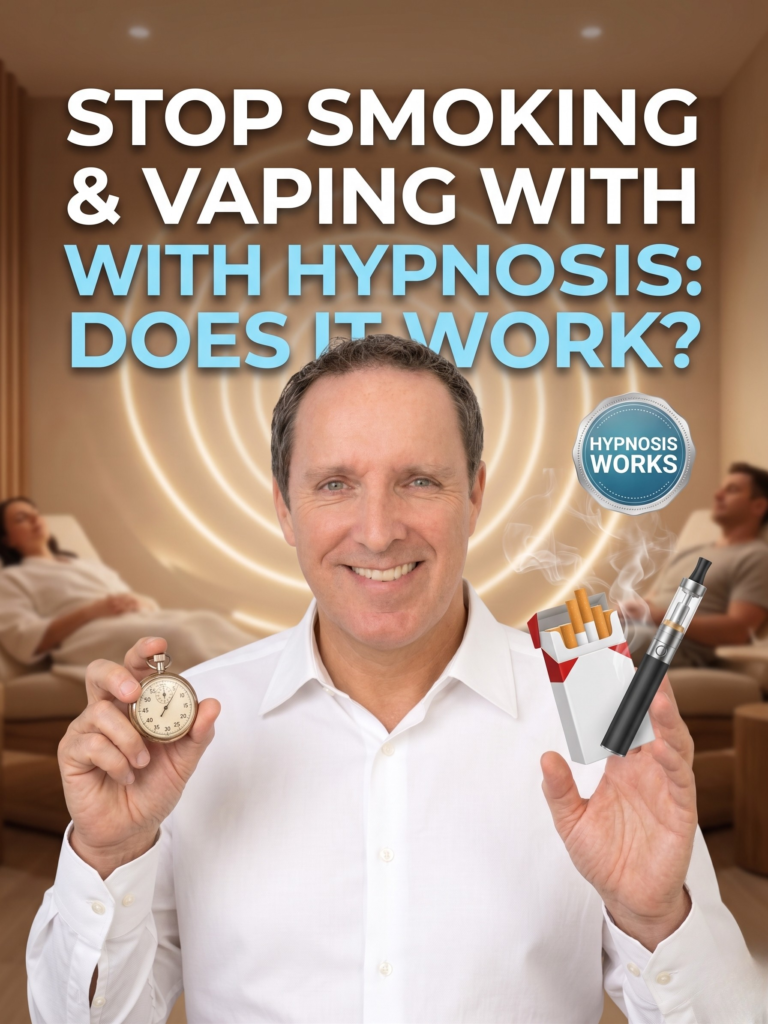
Hypnosis to stop smoking and vaping isn’t some fringe therapy your weird cousin found on TikTok. It’s a clinically studied method that targets the one thing patches, gum, and sheer willpower completely ignore: your subconscious mind.
Why Hypnosis Works for Smoking and Vaping When Willpower Doesn’t
Here’s the part nobody talks about. Smoking and vaping aren’t really nicotine problems. They’re trigger problems. You light up after a meal. You vape when you’re stressed. You reach for it during a break at work because your hands need something to do. The nicotine is just the chemical riding shotgun on a deeply ingrained behavioral loop.
Willpower tries to fight that loop head-on. And for most people, it loses. Not because they’re weak, but because conscious effort is trying to override something that lives in the unconscious. It’s like trying to stop blinking by concentrating really hard. You might hold out for a minute, maybe a day, but eventually the automatic part of your brain wins.
Hypnosis takes a different approach entirely. Instead of fighting the trigger, it rewires it. During a hypnotherapy session, you enter a deeply relaxed state where your subconscious becomes more receptive to new associations. That post-meal craving? It gets redirected. That stress response that sends you reaching for a vape? It gets reprogrammed to reach for something healthier, or nothing at all.
This isn’t speculation. A study published in the International Journal of Clinical and Experimental Hypnosis found a 64% success rate for smokers who used hypnosis to quit. Another study showed 86% of participants were smoke-free at the six-month mark after hypnotherapy sessions. Those numbers beat most pharmaceutical interventions.
What Happens During a Hypnosis Session for Smoking
If you’ve never been hypnotized, you probably have a mental image involving a swinging pocket watch and someone clucking like a chicken. That’s stage hypnosis, and while Richard Barker does plenty of that (it’s hilarious, by the way), therapeutic hypnosis for quitting smoking is a completely different animal.
You sit in a comfortable chair. You close your eyes. The hypnotherapist guides you into a state of focused relaxation. You’re not asleep. You’re not unconscious. You’re in a heightened state of awareness where your analytical mind takes a back seat and your subconscious comes forward.
In that state, the therapist introduces new suggestions. Things like associating the smell of cigarette smoke with something unpleasant. Or creating a powerful mental image of yourself as a non-smoker, healthy and free. Or disconnecting the stress-smoking link so that when anxiety hits, your brain no longer defaults to “grab a cigarette.”
Most people need between one and three sessions. Some people quit after a single session. The key variable isn’t how many sessions you need. It’s how ready you are to stop.
Does It Work for Vaping Too?
Absolutely. And in some ways, vaping is even more responsive to hypnosis than traditional smoking. Vaping doesn’t carry the same physical ritual as lighting a cigarette, which means the habit is almost entirely psychological. There’s no match to strike, no ash to flick. It’s just hand-to-mouth, inhale, exhale. Pure behavioral automation.
That makes it a perfect target for hypnotherapy. The habit loop is simpler, which means it can be disrupted faster. Many vapers who’ve tried patches or nicotine replacement find that those methods don’t work because the real addiction isn’t chemical, it’s psychological. Hypnosis goes straight to the source.
The Science Behind Hypnosis and Nicotine Addiction
Your brain has a reward system. Every time you smoke or vape, dopamine fires. Over time, your brain builds a superhighway between the trigger (stress, boredom, social setting) and the response (nicotine). That superhighway is fast, efficient, and extremely hard to demolish with conscious effort alone.
Hypnosis doesn’t demolish the highway. It builds a detour. By accessing the subconscious during a relaxed state, new neural pathways get laid down. The old trigger still fires, but now it connects to a different response. Deep breathing instead of inhaling smoke. A glass of water instead of a vape hit. Eventually, the old highway deteriorates from lack of use.
This is why hypnosis works differently from nicotine replacement therapy. NRT addresses the chemical dependency but ignores the behavioral one. Hypnosis addresses the behavioral dependency directly. The most effective approach for heavy smokers often combines both, tackling the problem from two angles simultaneously.
Who Is Hypnosis Best Suited For?
Hypnosis isn’t a magic pill, and honesty matters here. It works best for people who genuinely want to quit. If someone drags you to a hypnotherapist but you secretly plan to buy a pack on the way home, no amount of suggestion is going to stick. Your subconscious knows when you’re faking commitment.
That said, if you’re motivated but struggling, hypnosis might be exactly what fills the gap. It’s particularly effective for people who’ve tried quitting before and failed. Repeat quitters. The ones who’ve done the patch, done the gum, tried cold turkey three or four times. Those people already have the motivation. What they’re missing is the subconscious reprogramming.
It’s also worth knowing that about 75% of people are hypnotizable to some degree. The remaining 25% can still benefit from relaxation techniques used in hypnotherapy, they just might not go as deep. If you’re curious whether you’d be a good candidate, reach out to Richard Barker directly and ask.
Richard Barker’s Final Thoughts
I’ve watched people walk into my office convinced they’d never quit. Decades of smoking. Failed attempts stacked up like parking tickets. And then, after one or two sessions, something shifts. They stop reaching for the pack. They stop hitting the vape. Not because they’re fighting the urge, but because the urge is gone. That’s what hypnosis does when it works. It doesn’t give you more willpower. It removes the need for it. If you’re ready to stop smoking or vaping, book a session at incrediblehypnotist.com.
Try the Hypnosis Hub App Free
If you want to experience hypnosis for yourself, the Hypnosis Hub app is the easiest place to start. It includes a free guided breathing program to calm your nervous system on demand, plus a full hypnosis audio session designed to help you sleep deeper and break the insomnia cycle. No subscription required to try it.
Download Hypnosis Hub Free — or scan the QR code above from your phone.
Hypnosis for Smoking and Vaping FAQs
How many hypnosis sessions does it take to quit smoking?
Most people see results within one to three sessions. Some quit after a single session, while others benefit from reinforcement visits. The number depends on how long you’ve smoked, how strong the habit triggers are, and how committed you are to quitting. Your hypnotherapist will tailor the approach to your specific situation.
Is hypnosis for quitting vaping different from quitting smoking?
The core technique is the same, but vaping habits tend to be more psychologically driven and less ritualistic than cigarette smoking. This often makes vaping habits easier to reprogram through hypnosis because the behavioral loop is simpler. The subconscious triggers are targeted the same way, just with different associations specific to the vaping habit.
Can hypnosis help if I’ve failed to quit smoking before?
Yes, and this is where hypnosis shines. People who’ve tried quitting multiple times usually have strong motivation but lack the subconscious reprogramming to make it stick. Hypnosis addresses exactly that gap. Failed past attempts don’t predict future failure with hypnotherapy because it works on a completely different level than patches, gum, or willpower.
