

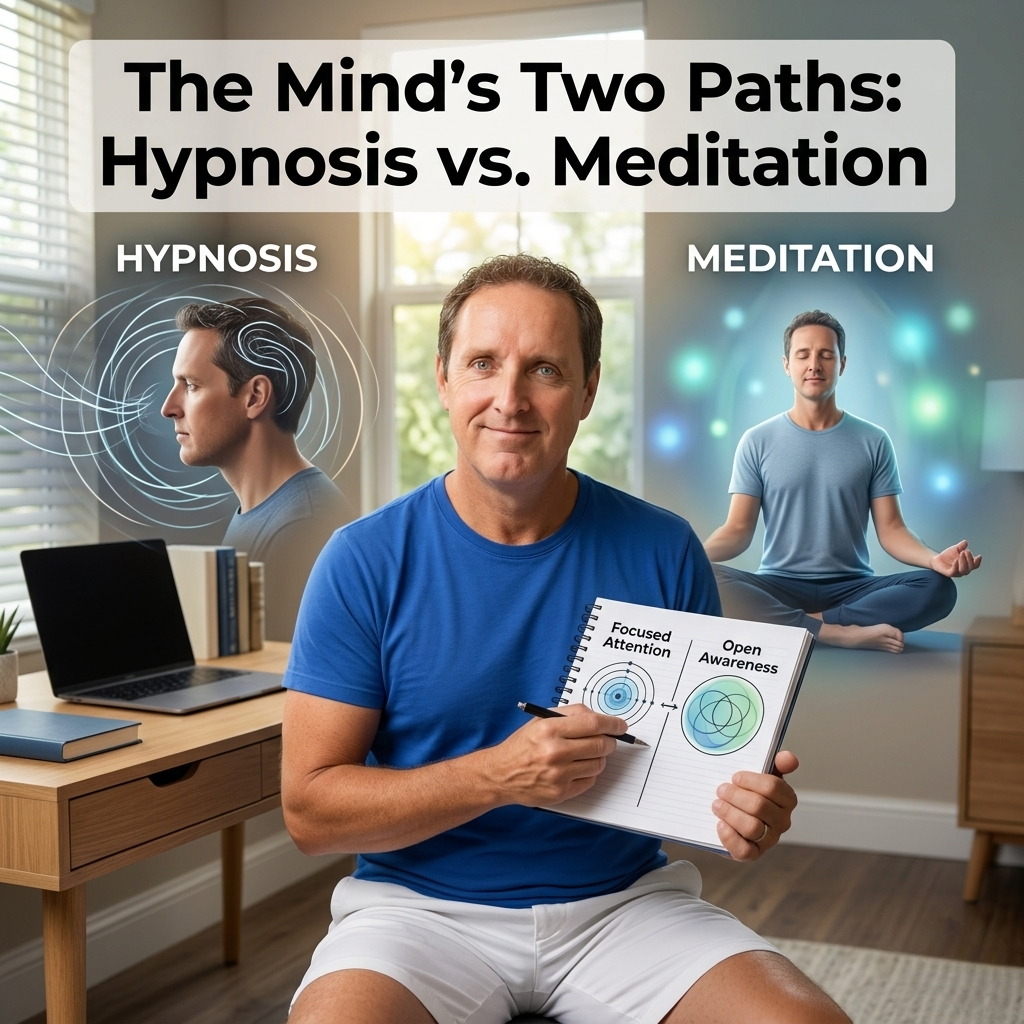
Hypnosis vs meditation is one of those questions I get asked constantly. People assume they’re basically the same thing. Close your eyes, relax, zone out. Same deal, right? Not even close. They share some surface level similarities, but the mechanics underneath are completely different. And understanding that difference might change how you approach both.
Hypnosis vs Meditation: Two Tools, Two Jobs
Here’s the simplest way I can put it. Meditation is about being. Hypnosis is about doing.
When you meditate, you’re training your mind to observe without reacting. You sit, you breathe, you notice thoughts floating by like clouds. You don’t chase them. You don’t try to fix anything. The whole point is presence. Being right here, right now, without judgment.
Hypnosis flips that on its head. You’re not sitting still and observing. You’re going in with a mission. Want to reduce anxiety? Quit smoking? Build confidence? Hypnosis targets a specific outcome and works directly with your subconscious mind to get there. It’s precise. It’s intentional. And it tends to work a lot faster than people expect.
How They Feel Different
Both hypnosis and meditation involve relaxation. That’s where the confusion starts. You’re calm in both. Your body settles. Your breathing slows down. From the outside, someone watching you do either one would probably think you’re just sitting there with your eyes closed.
But the internal experience is night and day.
In meditation, your awareness expands. You become more conscious of your thoughts, your body, the sounds around you. It’s like turning up the volume on your senses. Experienced meditators describe it as feeling more awake than usual, not less.
Hypnosis narrows your focus. Instead of expanding awareness, you’re funneling it into a single point. Most people describe it as somewhere between being fully awake and drifting off to sleep. You’re conscious the entire time, you can hear everything, but the outside world fades into the background. Your subconscious mind moves to the front of the room.
That’s the sweet spot. That’s where the change happens.
The Speed Factor
This is where hypnosis really pulls ahead for people who want results quickly.
Meditation is a long game. You build the skill over weeks and months. The benefits compound over time, better focus, lower stress, improved emotional regulation. But nobody sits down to meditate for the first time and walks away a changed person. It takes practice. Consistency. Patience.
Hypnosis can create noticeable shifts in a single session. I’ve seen people break habits they’ve carried for decades after one or two sessions. Not because hypnosis is magic. Because the subconscious mind doesn’t need repetition to learn something new. It just needs the right suggestion delivered at the right time, in the right state.
Think of it this way. Meditation is like going to the gym regularly. You get stronger over time. Hypnosis is like surgery. You go in, fix the specific problem, and come out different.
Can You Use Both Together?
Absolutely. And I’d recommend it.
Meditation builds your baseline awareness and emotional resilience. It trains you to notice what’s going on inside your head without getting swept up in it. That’s valuable every single day.
Hypnosis goes deeper when you need targeted change. When there’s a specific pattern, fear, or behaviour you want to rewire, that’s where hypnosis does its best work. It reaches the parts of your mind that meditation observes but doesn’t directly interact with.
People who meditate regularly often find they respond even better to hypnosis sessions. Their minds are already trained to relax and focus, which makes the hypnotic state easier to access. It’s a natural pairing.
Common Myths That Confuse People
Let’s clear up a few things that keep people mixing these up.
“Hypnosis is just guided meditation.” No. Guided meditation uses visualisation and narration to deepen a meditative state. Hypnosis uses specific language patterns and suggestions to communicate with the subconscious mind. The structure, the intent, and the outcome are all different.
“You lose control during hypnosis.” You don’t. You’re fully in control the entire time. You can open your eyes, speak, or stop the session whenever you want. Your subconscious mind won’t accept suggestions that conflict with your values or beliefs. It’s one of the most common misconceptions out there.
“Meditation is safer than hypnosis.” Both are completely safe. Neither one involves drugs, invasive procedures, or altered states that you can’t come out of. You naturally drift in and out of hypnotic states every day without realising it. Driving on autopilot, getting lost in a book, zoning out during a meeting. That’s all mild hypnosis.
Which One Should You Try First?
If you’re looking for general stress relief, better focus, or a daily mental health practice, start with meditation. Apps like Headspace or Calm are solid entry points. Build the habit.
If you’ve got something specific you want to change, hypnosis is the faster route. Whether it’s anxiety, sleep issues, confidence, habits, or pain management, hypnosis speaks directly to the part of your brain that runs those programmes.
And if you’re already meditating and feeling like you’ve hit a ceiling, hypnosis might be the next level you didn’t know existed.
Richard Barker’s Final Thoughts
I’m a fan of both practices. Meditation keeps you grounded. Hypnosis gets things done. They’re not competitors, they’re complements. But if someone tells me they’ve been meditating for years and still can’t shake a bad habit or quiet a specific fear, I already know what they need. The subconscious doesn’t respond to observation. It responds to direction. That’s what hypnosis provides.
Try the Hypnosis Hub App Free
If you want to experience hypnosis for yourself, the Hypnosis Hub app is the easiest place to start. It includes a free guided breathing program to calm your nervous system on demand, plus a full hypnosis audio session designed to help you sleep deeper and break the insomnia cycle. No subscription required to try it.
Download Hypnosis Hub Free — or scan the QR code above from your phone.
Hypnosis vs Meditation FAQs
Is hypnosis the same as meditation?
No. While both involve relaxation and focused attention, they serve different purposes. Meditation trains present moment awareness and emotional balance through consistent practice. Hypnosis targets specific goals by working directly with the subconscious mind, often producing noticeable results in just one or two sessions.
Can hypnosis and meditation be used together?
Yes, and they complement each other well. Regular meditation builds mental discipline and awareness, which makes you more receptive to hypnosis. Using both creates a well rounded approach where meditation handles your daily mental fitness and hypnosis addresses specific issues you want to resolve.
Which works faster, hypnosis or meditation?
Hypnosis typically delivers faster results for specific goals. People often notice changes after a single session. Meditation is a longer term practice where benefits build gradually over weeks and months. If you need targeted change quickly, hypnosis is the more efficient tool.
Is hypnosis safe compared to meditation?
Both are completely safe. Hypnosis doesn’t involve losing consciousness or control. You remain aware throughout the session and can stop at any time. Your brain enters mild hypnotic states naturally every day, like when you zone out while driving or get absorbed in a film.
